Key takeaways
- F&B capture rate = covers from in-house guests ÷ in-house guests, measured per meal period. Measure it by outlet and by meal, not as one average.
- In CBRE's US data for H1 2025, F&B revenue per occupied room rose 3.8%, faster than total hotel revenue (3.0%) and much faster than room revenue (0.8%). Resort banquet revenue rose 8.7%.
- J.D. Power found 77% of guests at large third-party-managed branded hotels dined on property in 2025, up from 73%, while satisfaction with F&B quality fell.
- At an illustrative 300-room resort, raising dinner capture from 30% to 35% is worth about EUR 328,000 a year.
- Labor is 59.4% of F&B department expenses. Capture gains that do not need more staff, such as ordering from the room or the pool, protect margin.
What F&B capture rate means
Hotel F&B capture rate is the percentage of in-house guests who dine or drink at the hotel's own outlets during a defined period. It is calculated by dividing covers served to in-house guests by the number of in-house guests. It is measured per meal period and per outlet, so a resort usually tracks several capture rates, not one.
The formula:
F&B capture rate = covers from in-house guests ÷ in-house guests (for the same meal period)
Two practical points:
- Count guests, not rooms. A resort with 1.9 guests per occupied room has almost twice as many potential diners as rooms.
- Separate included meals. If breakfast is in the rate, breakfast capture tells you about guest behavior, not revenue. The commercial capture rates are usually lunch, afternoon, dinner, bar and room service.
Why F&B is the bright spot at resorts
CBRE Hotels Research analyzed 2,669 US full-service, resort and convention hotels for the first half of 2025. The pattern was consistent: F&B grew while rooms stalled.
| CBRE, US hotels with F&B, H1 2025 vs H1 2024 | Change |
|---|---|
| Room revenue | +0.8% |
| Total hotel revenue | +3.0% |
| F&B revenue per occupied room | +3.8% |
| Food revenue in hotel outlets | +5.2% |
| Banquet revenue, resort hotels | +8.7% |
| Banquet revenue, convention hotels | -7.3% |
CBRE notes that the strongest increases were at luxury and resort hotels, helped by leisure demand and high-income travelers. Listed resort owners report the same. DiamondRock Hospitality said out-of-room revenue per occupied room at its resorts grew nearly 7% in Q4 2025, accelerating from 4% at the start of the year.
When room rate is hard to push, the guest who is already on property and already paying for the room becomes the most valuable growth channel you have. We made the same argument for the whole stay in Hotel Revenue Management Stops at Check-In.
More guests eat in, but they are less happy about it
J.D. Power's 2025 benchmark of branded hotels run by the largest third-party management companies found that 77% of guests dined at the hotel, up from 73% in 2024. In the same study, satisfaction with F&B quality and taste declined.
That combination is a warning. Guests are giving your outlets a chance, but cost-cutting that guests can see, in quality, presentation or service, reduces both satisfaction and spend. More capture is only worth having if the experience holds up.
Where resort capture leaks, meal by meal
Average capture hides the problem. A Horwath HTL and EDG study of hotel restaurants found that all-day dining capture rarely breaks 70%, and that properties capture only about half of in-house guests for breakfast. The same study uses a benchmark of 1.2 to 1.5 seat turns per meal period for a successful restaurant.
At resorts, the typical leaks look like this:
| Meal period | Common leak | Why it happens |
|---|---|---|
| Breakfast (not included) | Guests eat in town or skip | Price shown only at the door; no pre-ordering |
| Lunch | Guests at the pool or on the slopes never come in | The outlet is far from where guests are |
| Afternoon | No offer at all | Kitchen is "between services" |
| Dinner | Guests book elsewhere before arrival | Reservations not offered early enough |
| Bar | Guests go to their room after dinner | No reason to stay, no visible offer |
| Room service | Guests do not know the menu or the hours | Paper menu, phone ordering, long wait |
Each line is a different fix. That is why one capture rate for the whole resort is not enough.
Run the arithmetic on your own resort
Take an illustrative 300-room resort at 70% occupancy with 1.9 guests per occupied room. That is about 399 in-house guests on an average night. Assume a current dinner capture rate of 30% and an average dinner check of EUR 45 per guest.
| Dinner capture rate | Extra covers per night vs 30% | Extra dinner revenue per year |
|---|---|---|
| 35% | about 20 | EUR 327,700 |
| 40% | about 40 | EUR 655,400 |
| 45% | about 60 | EUR 983,000 |
Five points of dinner capture at this resort is worth about EUR 328,000 a year, and that is one meal period at one price. Add bar, lunch by the pool and room service, and the numbers grow quickly.
Notice what this does not require: no new rooms, no higher room rate, no extra advertising, and no commission. These guests are already in the building.
Want this math run on your own resort? We do it in the demo.
Labor is the real constraint
CBRE reports that labor makes up 59.4% of F&B department expenses, compared with 24.0% for cost of goods sold. That is why many resorts hesitate to push capture: more covers can mean more staff, and staff are hard to find in seasonal locations.
The answer is to raise capture in ways that do not add the same amount of labor:
- Let guests order from their own phone in the room, by the pool or on the terrace, so no one has to take the order by phone or walk to the table to write it down.
- Move demand into quieter hours, such as an afternoon menu or an early dinner offer, instead of adding pressure to the peak.
- Pre-sell dinners and special menus before the day, so the kitchen can plan and waste less.
Five ways to raise F&B capture
1. Put every outlet's menu in every room. A QR code in each room that opens all menus, with prices, hours and photos, does more than a printed folder. With Qreadible's Ordering & Requests, guests order room service or book a table from their own phone, and the order goes straight to the right team.
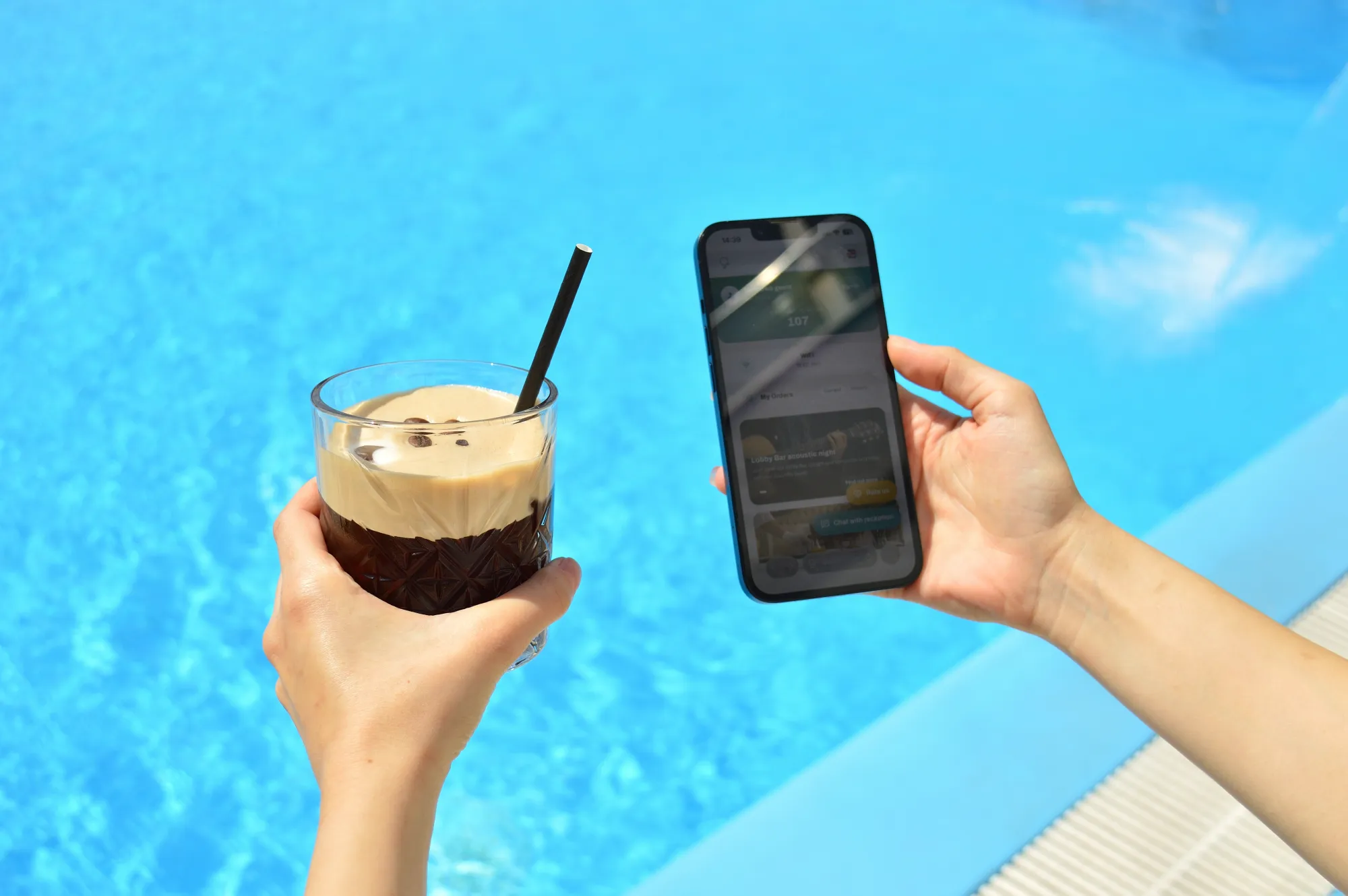
2. Bring the menu to where guests are. At resorts, guests spend the day at the pool, the beach, the spa or on the mountain. QR codes on sun loungers, terrace tables and in the spa lounge turn those places into points of sale.
3. Sell dinner before guests make other plans. Offer dinner reservations and special menus before arrival and on the first afternoon. Promotions & Revenue lets you send offers at the moment a guest is most likely to say yes.
4. Give the afternoon a product. Coffee and cake on the terrace, an aperitivo hour or a light menu after the spa fills a period most kitchens leave empty. Pair it with the spa, as we describe in Spa Treatment Room Utilization.
5. Track capture by outlet, every week. If you cannot see it, you cannot manage it. Use the scorecard below.
An F&B capture scorecard
Review these numbers weekly, by outlet:
| Metric | What it tells you |
|---|---|
| Capture rate by meal period | Whether in-house guests choose your outlet |
| F&B revenue per occupied room | Whether capture turns into spend |
| Average check per in-house guest | Whether you sell up or only sell more |
| Room service orders per 100 occupied rooms | Whether guests know the in-room option exists |
| Share of orders placed digitally | How much of the order-taking labor you have removed |
| Seat turns per meal period | Whether the outlet is full or just busy at peak |
Two quick checks before your next F&B meeting: do you know last week's dinner capture rate, and does anyone own it?
Where this leaves F&B
F&B is growing faster than rooms at resorts, and more guests are willing to eat on property. That makes hotel F&B capture rate one of the most valuable numbers a resort can manage. The resorts that win will measure it by meal and outlet, put menus where guests actually are, and let guests order without waiting for a person.
Guest adoption is often less of a barrier than teams expect. At The Gotham Hotel in Manhattan, 89% of guests used Qreadible during their stay. Resort guests, with more free time on property, have even more reasons to order.
Start with one number. Calculate last week's dinner capture rate. Then ask what it would be worth at five points higher.
Qreadible is the revenue engine for spa and mountain resorts: in-room and poolside ordering, timed offers to in-house guests, and a monthly report of what sold. Book a demo to see what it would earn at your resort.